How AI Could Address the Speech-in-Noise Gap for Cochlear Implants
TLDR
Cochlear implant users often understand speech well in quiet settings but struggle when multiple voices compete.
This discussion highlights how a machine learning pre-processing layer could isolate a target speaker before the signal reaches the implant processor, potentially improving real-world speech understanding without replacing existing device hardware.
What this insight highlights
- Speech-in-noise remains one of the largest unresolved challenges for cochlear implant users, even when performance in quiet environments is strong.
- A recurring constraint described here is biological. Cochlear implants replace thousands of hair cells with roughly a dozen electrodes, compressing the auditory signal and limiting the brain’s ability to separate competing voices.
- This discussion highlights a focused role for AI. Instead of replacing device hardware, machine learning could operate as a pre-processing layer that isolates a target speaker before the signal reaches the implant processor.
- Technical feasibility depends heavily on operational realities such as compute capacity, microphone variability across device platforms, and integration with existing processors.
- Performance must be evaluated using validated audiology outcome measures that reflect real improvements in speech understanding during noisy listening conditions.
Decisions this enables
- Prioritize AI initiatives that target clearly defined functional limitations rather than broad exploratory applications.
- Consider augmentation strategies that enhance existing medical device architectures instead of requiring full hardware redesign.
- Adopt pilot-first development approaches when pursuing high-uncertainty healthcare AI applications.
- Treat product decisions such as target speaker selection as central design questions. Determining whose voice should be enhanced requires clear assumptions about user intent.
- Align AI evaluation with clinical outcome measures already used in audiology practice to ensure meaningful improvements for patients.
Risks if ignored
- Speech-in-noise limitations may continue to restrict social participation, workplace communication, and overall quality of life for cochlear implant users.
- AI programs that move directly toward productization without feasibility validation risk costly integration failures.
- Product teams may focus on model performance while overlooking deployment constraints such as compute limits, signal mismatch, or device platform differences.
- Evaluation frameworks based only on model metrics may fail to demonstrate meaningful real-world improvement.
Suggested next steps
- Identify clinical problems where AI can augment existing medical device capabilities rather than replacing device architecture.
- Run feasibility pilots using realistic speech-in-noise scenarios and validated audiology outcome measures.
- Evaluate deployment pathways early, including compute requirements, device compatibility, and potential collaboration with implant manufacturers.
Source
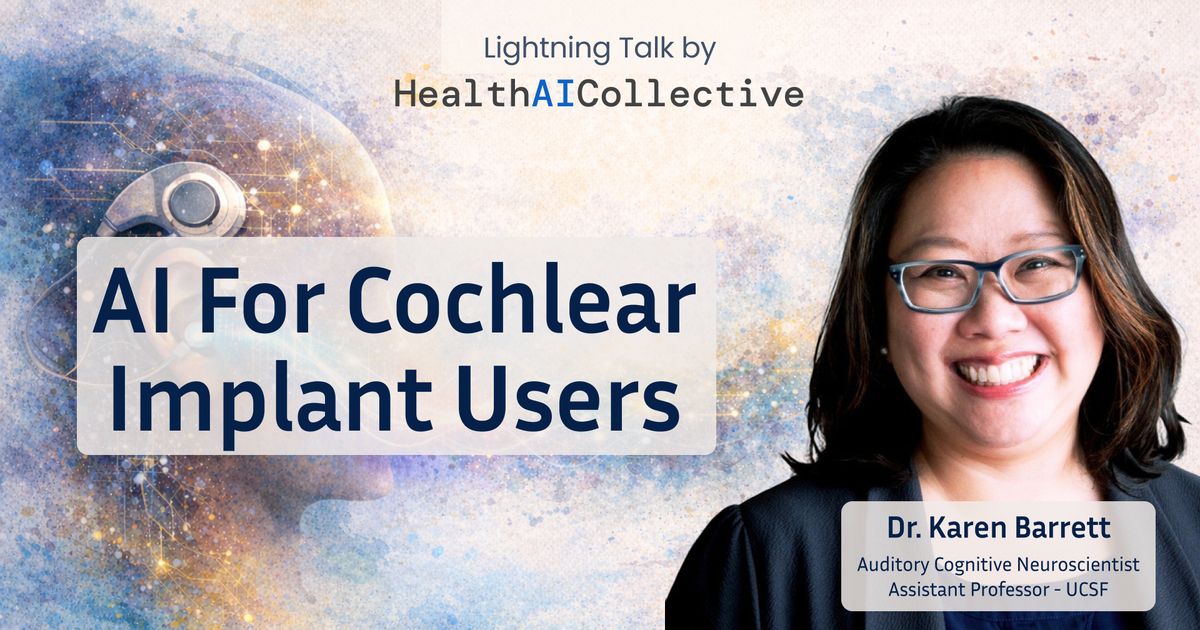
This executive insight is based on a lightning talk hosted by Health AI Collective, featuring Karen Barrett, Assistant Professor at the University of California, San Francisco. Read the full community insight:
https://healthaicollective.com/insights/ai-speech-in-noise-cochlear-implants-healthcare